
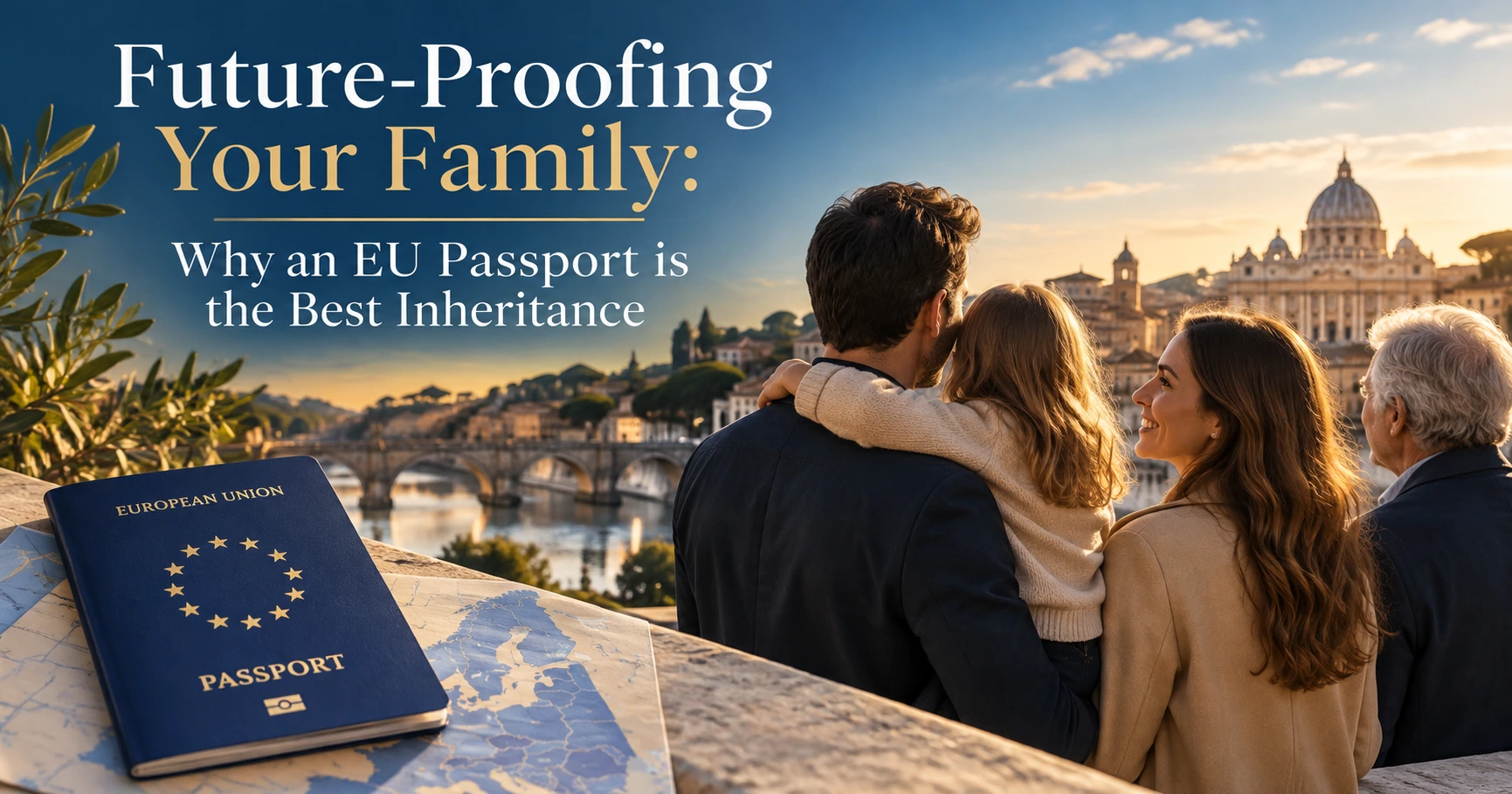
For North American families with European ancestry, citizenship by descent can be more than a travel convenience. If you are eligible for citizenship in an EU member state, recognition of that status may create long-term options for where you and your children can live, work, study and build a future. The important distinction is that these rights come from citizenship itself—not from the passport document—and the rules for passing citizenship to children depend on the nationality law of the country involved.
That makes European citizenship a useful family-planning question as well as an ancestry question. The goal is not to assume that a passport automatically passes from one generation to the next, but to understand whether citizenship can be recognized, transmitted and documented in your specific family line.
An EU passport represents citizenship rights—not just easier travel
A passport is a travel document issued to a citizen. The underlying legal status is citizenship. For citizens of an EU member state, EU law generally provides rights to move and reside in other EU countries, and EU nationals can work in another EU country without a work permit. Longer stays and certain categories of residence can still involve conditions or administrative formalities, so the practical rights should be checked for the destination and circumstances involved.
For a family thinking decades ahead, that distinction matters. The long-term value is not simply shorter airport lines or easier vacations. It is the possibility of maintaining a legal connection to Europe that may expand future choices for work, education, residence and family life.
Why EU citizenship can matter for future generations
When citizenship can legally be passed to children, it may become an intergenerational asset: a status that can preserve options even if the family continues living in Canada or the United States. Depending on the country and the child’s circumstances, those options can include:
- Mobility: the ability, as an EU citizen, to move to and reside in another EU country subject to the applicable EU rules and formalities.
- Employment: access to work in other EU countries without needing a work permit as a non-EU national would.
- Education: the option to study in Europe, with admission, tuition and student-support rules determined by the country and institution.
- Family flexibility: more choices about where future generations may live, establish careers or raise families.
- Heritage continuity: a documented legal connection to the country of origin, not only a genealogical connection.
Can EU citizenship be passed to children?
Sometimes—but there is no single EU-wide rule for citizenship by descent. Nationality law is set by each country. In some systems, a child may acquire citizenship automatically at birth if a parent was already a citizen. In others, registration, declaration, recognition or additional documentation may be required. Some countries also apply rules related to birth abroad, generational limits, retention of citizenship, naturalization history or the date on which a parent’s citizenship was recognized.
The practical question is therefore not simply, “Do I have an EU passport?” It is: “Under the nationality law of the country involved, was I a citizen at the relevant time, and what does that country require for my child?”
Because those rules can change, country-specific eligibility should be reviewed before relying on a general online summary or assuming that one family member’s outcome will automatically apply to another generation.
Timing may matter before the next generation is born
For people who may qualify for European citizenship by descent, timing can be important. In some nationality systems, a parent’s citizenship status, registration or recognition before a child is born can affect the child’s position. Other systems may impose deadlines or formal registration requirements for children born abroad.
That does not mean every eligible adult should rush an application. It means families who are planning for children—or who already have minor children—should verify the transmission rules early enough to understand whether any action is time-sensitive.
The document chain is a real family asset
Even when the legal basis for citizenship is strong, future applications can become difficult if the documentary chain is incomplete. Families should preserve records that connect each generation clearly and consistently.
- Long-form birth certificates and civil registration records
- Marriage, divorce and death certificates where relevant
- Citizenship certificates, nationality records and passports
- Naturalization records or proof that an ancestor did not naturalize before a legally significant date
- Records of legal name changes, adoptions or spelling variations
- Consular registrations, foreign birth registrations or similar proof where required
Keep originals secure and maintain high-quality copies. Where certified copies, apostilles or translations are needed, confirm the current requirements of the responsible authority before paying for large volumes of documents.
Common mistakes families make when planning citizenship by descent
- Treating a passport and citizenship as the same thing. The passport is evidence and a travel document; citizenship is the legal status.
- Assuming all EU countries use the same inheritance or descent rules. They do not.
- Assuming citizenship will automatically pass forever. Transmission can be limited by national law, generation, timing or registration requirements.
- Waiting until a child is an adult before checking whether a registration deadline applied during childhood.
- Ordering expensive foreign records and translations before confirming that the family line is potentially eligible.
- Ignoring naturalization dates, name changes, historical borders or changes in nationality law that can affect the chain.
- Relying on social-media examples that involve a different country, generation or set of facts.
A practical family legacy plan
If your goal is to preserve European citizenship options for your family, a structured approach is more useful than collecting documents at random:
1. Map the family line. Write down the full names, dates and places of birth for the relevant parent, grandparent, great-grandparent or earlier ancestor.
2. Gather what the family already has. Collect passports, citizenship papers, civil records, naturalization records and old identity documents before ordering replacements.
3. Flag legal or documentary complications. Note name variations, adoptions, divorces, historical border changes and possible naturalization events.
4. Review eligibility country by country. Citizenship by descent rules are national, so the family line should be assessed under the law of the specific country involved.
5. Confirm the current filing requirements. Before submission, verify the current rules of the responsible consulate, registry, ministry or other authority, including translation, legalization and appointment requirements.
6. Preserve the result for the next generation. Once citizenship is recognized, keep the certificates and registrations that future children or descendants may need to establish their own status.
How EuroPassport can help
EuroPassport focuses on European and UK citizenship by ancestry for clients in Canada and the United States. Its published process includes eligibility assessment, ancestry-document research, application-file preparation, coordination of supporting documents and translations, and work with legal professionals in Europe. Because every family line is different, an eligibility review is a practical first step before committing to a full document-retrieval and application process.
Start with the EuroPassport Eligibility Assessment to review the family line and country-specific eligibility before moving forward.
Frequently Asked Questions
Is a passport the same as citizenship?
No. Citizenship is the legal status. A passport is a travel document issued to a citizen and can serve as evidence of nationality.
Can EU citizenship automatically pass to my children?
Not in every case. The rules depend on the nationality law of the specific country, the parent’s status at the relevant time, the child’s place and date of birth, and any registration or transmission requirements.
Can citizenship by descent continue for multiple generations?
It can in some countries and family lines, but not universally. Some countries impose generational limits, registration requirements or other conditions for descendants born abroad.
Should I review eligibility before my child is born?
If you believe you may qualify by descent, an early review can be useful because timing or registration can matter in some systems. The exact effect depends on the country.
Can an EU citizen live and work in another EU country?
EU citizens generally have free-movement rights under EU law and can work in another EU country without a work permit. Residence beyond short stays can be subject to conditions and administrative formalities.
Why review eligibility before ordering records?
Foreign civil records, certifications, apostilles and translations can be time-consuming and expensive. Confirming the likely legal route first helps families focus on the documents that are actually relevant.
Suggested internal links for publication
Important note
This article provides general information and is not legal, tax, financial or immigration advice. Citizenship, residence, tax, education, healthcare and family-law rules vary by country and can change. Eligibility, transmission rules and obligations should be confirmed for the applicant’s specific facts before action is taken.